

Beschreibung
Erhaltung: ss+ | Abkürzungen
Katalognummer: Laranda
Durchmesser: 10,00 mm
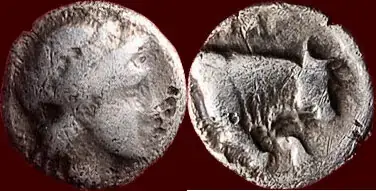
weight 0,69gr. | silver Ø 10mm.
obv. Baal seated left, holding corn-ear with bunch of grapes and scepter,
within dotted circle
rev. Forepart of wolf right, crescent pointing upward above, within dotted circle
Laranda (modern Karaman) was one of the most important towns of Lycaonia. In the 6th century BC it came under Achaemenid rule until 322 BC, when it was destroyed by Perdiccas, a former general of Alexander the Great, after he had defeated Ariarathes, king of Cappadocia. It later became a seat of Isaurian pirates. It belonged to the Roman and later Byzantine Empire until it was captured by the Seljuks in the early 12th century. Karaman was occupied by Frederick Barbarossa in 1190 and by Armenian Kingdom of Cilicia between 1211 and 1216. In 1256, the town was taken by Karamanoğlu Mehmet Bey and was renamed Karaman in his honour. From 1275, Karaman was the capital of the Karamanid beylik.
Baal was the title of various Gods of fertility, weather, rain, wind, lightning, seasons, war, patron of sailors and sea-going merchants, leader of the Rephaim (ancestral spirits). In fact Baal was a title and honorific meaning owner, lord in the Northwest Semitic languages spoken in the Levant during antiquity. In Sumerian EN, the Akkadian Bēlu and Northwest Semitic Baal was used as a title of various deities in the Mesopotamian and Semitic pantheons. Only a definitive article, genitive or epithet, or context could establish which particular god was meant. Baal was also used as a proper name by the third millennium BC, when he appears in a list of deities at Abu Salabik ( a small Sumerian city around 20 km northwest of the site of ancient Nippur. The Phoenician Baal is generally identified with either El or Dagan. Also in Canaan Baal was worshipped under various names, also as El | the leader of the gods and patron of kingship, who was connected to the regions dependence on rainfall for its agriculture. He fought various mythical snake-monsters asthe Yammu (now generally regarded as the prototype of the vision recorded in the 7th chapter of the biblical Book of Daniel), Tannin and Litan. In Canaan we also know Baal as Mot, the Canaanite death god, he was known as Baal Rāpiuma. Also the Hebrean God Jah-Weh was a synonym for Baal and means the same Lord. So Baal was not one God, but a synonym for a range of various Gods in ancient antiquity.
This cointype was formerly attributed to Tarsos (Cilicia).
BMC- (cf. 86) | SNG.Copenhagen- (cf. 317) | SNG.von Aulock 8655
SNG.Schweiz (Levante)(cf. 225) | SNG.France 450 | Slg. Klein- (cf. 650)
Weber collection- (cf. 7638) | Göktürk- | Sear- (cf. 5660) R
vf+