

Beschreibung
Katalognummer: Beckum
Durchmesser: 28,00 mm
weight 4,90gr. | copper Ø 28mm.
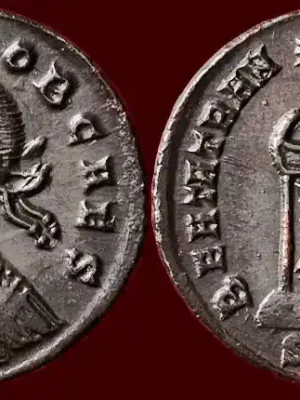
obv. City coat of arms resting on an ornamented shield in circle,
surrounded by the legend STADT BECKEM
rev. Value XII with date 1-6-2-2 between in ornamented square
Beckum is a town in the northern part of North Rhine-Westphalia, Germany. It is about 20 km (12 miles) north-east of Hamm and 35 km. south-east of Münster. It gives its name to the nearby Beckum Hills. In late antiquity and the early Middle Ages the area was first inhabited by Bructeri, later perhaps by both Franks and Saxons. Around 785, the first Christian church was built where the current St. Stephens Church stands. A foundation was established there in the 12th century, which fell under the ecclesiastical rule of the bishops of Münster. In 1224, Beckum was granted its town charter, and it quickly grew in wealth as merchants and craftsmen set up businesses in the town. The town quickly expanded to an area of over 22 km2. However wars, riots and the Black Death in the following centuries left their mark on the town. Beckum, situated at the intersection of two old trade routes, gained increasing importance as a trading town in the Middle Ages and joined the Hanseatic League in or before 1433. During the Spanish winter of 1598/99, Beckum was largely destroyed by Spanish soldiers. This ushered in two centuries of misery. In the 17th century, the town suffered greatly during the Thirty Years War (1618-1648), and afterward, Beckum was repeatedly struck by war, plague and other disease epidemics, fires, livestock diseases, and so on. After the Thirty Years War, legislation removed several rights from cities and towns, and as a result many cities and towns in Münsterland became heavily economically and religiously dependent upon the Bishop of Münster.
This is a so called Kippercoin from the Kipperzeit (1620-1623). Kipper und Wipper (German: Kipper- und Wipperzeit) was a financial crisis during the start of the Thirty Years War (16181648). Starting around 1620, city-states in the Holy Roman Empire began to produce heavily debased currency in order to raise revenue for the Thirty Years War, as effective taxation did not exist. More and more mints were established until the debased metal coins were so worthless that children allegedly played with them in the street. The name derives from the practice of fraudulent coin devaluation, namely the wippen (rocking) of the balance beams when weighing the coins on a speed scale and the subsequent Kippen (Low German for sorting out) of the heavier pieces, from which new, lower-value coins were then made by adding copper, tin or lead. a very rare cointype
KM.6 | Weingärtner 109 | Wittenbrink 15 | de Mey 12 | Numista 279420 RR
f+